Welcome to my blog. I am a Google Diamond Product Expert and Mentor for Gmail and Google Account and here I write articles that explain various issues related to those two products as well as tutorials on topics that are either not available in the Gmail or Google Account Help Center articles, or are not available in the language the users want them to be in.
When folks come to Gmail for the first time, they instinctively expect it to work in exactly the same way as the traditional email services and desktop email clients they have grown used to.
But when Google created Gmail back in 2004, they had an opportunity to redefine email and how it worked from the ground up. So—being Google!—they did.
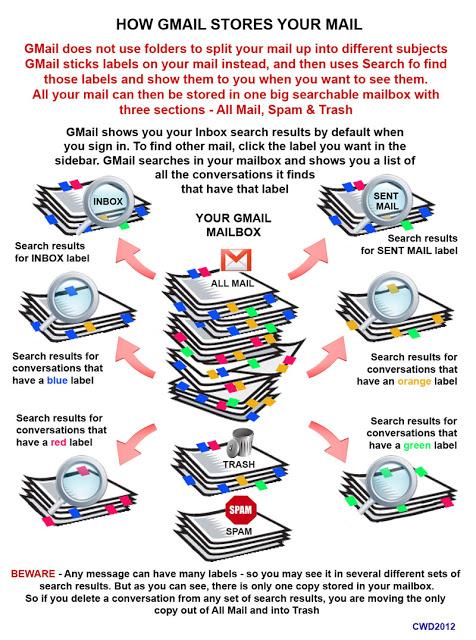
The result is a sleek and efficient email management system: no physical folders and no separate copies of a message simply because it is associated with different labels. Instead, Gmail organizes messages using labels, Search, threaded conversations, and other built-in features. Messages can be accessed through system labels such as Inbox and All Mail, while Spam and Trash are handled separately. But because this model differs from what most people know, it can and still does lead to confusion.
1. Labels Not Folders: The Core Storage Model
The chief source of confusion is the way Gmail organizes messages. Many users are accustomed to splitting their mail into separate folders according to subject, making copies where necessary, and deleting a message from one folder without affecting what appears elsewhere.
Gmail, on the other hand, doesn't put messages in subject folders—it puts subject labels on messages. And that's a whole new ballgame!
Gmail adds system labels like Inbox, Sent, and Important. Users add their own custom labels like Work, Vacation, Football, or Family. To see the messages associated with a label, click the label name in the sidebar. Gmail displays the messages associated with that label.
Because each message can carry multiple labels, the same message may appear in several label views. This can create the impression that duplicate messages exist, when the different views are simply showing the same message with different labels.
2. Common Pitfalls & Things Which Go Wrong
Deleting Sent Messages or Conversation Threads
In traditional folder-based email clients, users may think of a message in Sent as a separate copy stored in a Sent folder. Gmail does not work that way. A message can be associated with system labels such as Sent and Inbox, but those labels do not represent separate copies of the message. When you delete a message, it is moved to Trash and is no longer available under its other labels.
Deleting Messages After Replying or Categorizing
Some users reply to a message, apply a project label, and then delete the message from their Inbox expecting the labeled version to remain. In Gmail, labels do not create separate copies of a message. Deleting the message moves it to Trash, so it is no longer available under its other labels. If you want to remove the message from the Inbox while keeping it available under its labels, archive it instead.
Remember: Messages in Trash and Spam are automatically deleted after 30 days.
3. Best Practices for Using Labels
Managing your mailbox with labels is fast, flexible, and completely customizable:
Applying Labels: Use Gmail's label controls to apply a label to selected messages, or use the available drag-and-drop options where supported.
Move to Label: The “Move to” option can move a message from the Inbox to a selected label, removing it from the Inbox in the process.
Color Coding & Visibility: Use the options available for a label in the Gmail sidebar to customize its color and visibility.
Nesting Labels: Organize related sub-topics by creating nested child labels under a parent label for a cleaner sidebar layout.
Deleting Labels Safely: If you delete a custom label you created, no emails are deleted. The label is removed, but the messages remain in Gmail and can still be found through other applicable labels, Search, or All Mail.
Imagine seeing a security-related notification or prompt about activity involving your Gmail or your Google Account. As part of checking what has happened, you should look for additional information that can help you understand the activity.
When the activity relates to your Gmail, one way to find out more is to click Details next to Last account activity. This opens the Activity Information window, where Gmail provides information about recent activity or access, particularly access related to your Gmail.
The Details link next to Last account activity at the bottom of the Gmail Inbox opens the Activity Information window.
You may visit this window while investigating a particular activity, or simply because you have decided to review your Gmail activity as part of your own periodic security checks. It is worth noting that this is a separate check from the Google Account Security Checkup. The Security Checkup takes you through a series of security-related checks as part of a single guided process, but it does not, as part of that process, direct you to review the Details information available through Last account activity in Gmail.
Once you open the window, however, you may find that the information is quite diverse and can include a considerable amount of technical detail. You may see entries such as Browser, POP3, Authorized Application, Mobile, or Unknown, without it being immediately obvious what each entry represents or how the information should be interpreted.
The Gmail Activity Information window showing recent activity entries and the information associated with them.
This is particularly worth understanding because the Activity Information window is not something most users encounter as a routine part of reviewing their Google Account security. Consequently, even someone who regularly checks their account security may find themselves looking at these entries without much context for interpreting them.
That is the purpose of this guide.
It explains the different types of entries you may encounter in the Activity Information window, what they generally represent, and—just as importantly—what they do not necessarily tell you. The aim is to provide the additional context you may need when reviewing this information, whether you arrived here because something caught your attention or simply as part of your own periodic security checks.
Gmail provides an official Help Center article, "Last account activity", which explains the information available through this feature and provides Google's guidance about activity that you do not recognize.
This guide is intended to complement, rather than replace, that Gmail Help Center article.
The Gmail Help Center provides Google's official product information and security guidance. This guide takes a more practical approach, focusing on the entries you may actually encounter and providing additional context to help you understand what you are seeing.
Before interpreting an entry
Before looking at the individual entries, there is an important point to keep in mind.
The information shown in the Activity Information window describes activity or access that Gmail has recorded. Depending on the type of activity, however, the information displayed may not identify the exact device, application, person, or action that produced the entry.
An entry that you do not immediately recognize therefore does not automatically mean that someone else has accessed your account.
At the same time, an unfamiliar entry should not simply be dismissed. If you cannot explain an activity, you should investigate it and consider the circumstances in which it was recorded.
In other words, unfamiliar and unauthorized are not necessarily the same thing.
Understanding that distinction is important when interpreting the entries described below.
Browser
A Browser entry indicates access to Gmail through a web browser.
This is the type of access you would normally expect when you open Gmail in a browser and use the Gmail web interface. Examples include Firefox, Chrome, Safari, and Microsoft Edge (Chromium).
Depending on the information displayed, the entry may also provide information about the browser being used.
A Browser entry in the Gmail Activity Information window.
A Browser entry, however, should not be interpreted as identifying a particular physical computer or the person using it. It tells you about the type of access Gmail recorded, rather than providing a complete description of who was using the browser.
If the date and time correspond to a time when you were using Gmail in a browser, the entry will generally have a straightforward explanation.
If they do not, you should look at the other information associated with the entry before deciding what it means.
POP3
A POP3 entry indicates access to Gmail using the POP (Post Office Protocol).
POP is a method used by mail applications (email clients) to retrieve messages from a Gmail account. Unlike accessing Gmail through a web browser, where you interact directly with the Gmail web interface, a POP connection allows another mail application or service to retrieve messages from your Gmail account.
Examples of email clients that can be configured to access Gmail using POP include Microsoft Outlook, Apple Mail, and Thunderbird.
For example, if you have configured an email client to retrieve messages from Gmail using POP, that activity can appear as a POP3 entry in the Activity Information window.
Gmail's Mail Fetcher feature can also be relevant when interpreting a POP3 entry. Mail Fetcher allows Gmail to retrieve messages from another mail account, rather than you accessing that other account directly through its own web interface.
Consequently, seeing a POP3 entry does not, by itself, mean that someone has installed an unfamiliar email client or is accessing your Gmail from an unknown computer.
If you use an email client or a Gmail feature that involves retrieving mail through POP, consider whether that could explain the entry.
You can also check the Forwarding and POP/IMAP tab in Gmail's settings for information that may help corroborate what you are seeing. In particular, check whether POP access has been enabled and whether the settings are consistent with the way you use Gmail. This can provide additional context when you are trying to determine whether a POP3 entry has an expected explanation.
A POP3 entry in the Gmail Activity Information window.
A POP3 entry associated with Gmail retrieving messages through POP3.
As with the other types of activity shown in this window, the date and time, IP address, and approximate location can provide additional information when you are trying to understand a particular POP3 entry. Those details should, however, be considered together rather than interpreted in isolation.
Authorized Application
An Authorized Application entry indicates activity associated with an application or program that has been authorized to access your Google Account, particularly Gmail.
This is different from simply signing in to Gmail through a web browser. An application or service may have been granted permission to interact with your Google Account, and activity associated with that authorization can be reflected in the Gmail Activity Information window.
The important point is that an Authorized Application entry does not, by itself, mean that an unknown third-party application has accessed your account.
You may have authorized the application yourself, possibly some time ago, and may no longer remember doing so. You may also have authorized an application or service for a particular purpose without realizing that activity associated with that authorization could subsequently appear in your Gmail activity information.
An Authorized Application entry associated with a mobile email application.
An Authorized Application entry associated with an IMAP mail client.
An Authorized Application entry associated with activity involving another Google service.
An Authorized Application entry associated with an external service retrieving messages from Gmail.
If you encounter an Authorized Application entry that you do not recognize, you should investigate the applications and services that have access to your Google Account. You can review the list of third-party apps and services with access to your Google Account—and the Google products they can access—on the "Third-party apps & services" page. The information there may help you corroborate whether an application or service you have previously authorized could provide an explanation for the activity shown in the Gmail Activity Information window.
However, the Activity Information entry by itself is not sufficient to identify the particular application involved, the exact action that took place, or whether the activity was authorized by you.
As with the other entries, consider the date and time, IP address, approximate location, and anything you were doing with your Google Account around that time. These details may help you put the entry into context.
Authorized Application ()
You may also encounter an entry displayed as:
Authorized Application ()
Note that the parentheses are empty.
This can be particularly confusing because the entry appears to identify an authorized application while providing no information between the parentheses.
There is, however, a useful observation that you can reproduce for yourself. An Authorized Application () entry can appear in connection with activity involving Security Checkup.
To reproduce this:
Open Gmail and click Details next to Last account activity.
This opens the Activity Information window.
In the Activity Information window, click Visit Security Checkup for more details.
Review or complete the relevant activity in Security Checkup.
Return to the Activity Information window and look at the entries listed there.
You may see an entry displayed as Authorized Application ().
Selecting Show details does not necessarily provide any additional information inside the parentheses.
An Authorized Application () entry with the Show details option.
The entry may subsequently disappear after a few minutes.
Refreshing the relevant information can cause the Authorized Application () entry to appear again.
The Authorized Application () entry after its details have been hidden.
Being able to reproduce the entry in this way is significant because it shows that Authorized Application () does not, merely because the parentheses are empty, mean that an unidentified third-party application has gained access to the account.
It is important, however, not to take this observation too far. The fact that the entry can be reproduced in connection with Security Checkup does not mean that every Authorized Application () entry is caused by Security Checkup. A similar entry encountered under different circumstances should still be investigated rather than automatically attributed to Security Checkup.
If you encounter an Authorized Application () entry, consider the date and time and what you were doing with your Google Account around that time. You can also review the list of third-party apps and services with access to your Google Account on the "Third-party apps & services" page. The information there may help you corroborate or rule out a possible explanation for the entry.
The important distinction is between what can be observed and what can be concluded from that observation. The empty parentheses do not, by themselves, show which application was involved or that the activity was unauthorized.
The reproducible Security Checkup observation gives you one possible explanation for this otherwise puzzling entry, but it should be treated as an example of how the entry can occur—not as a universal explanation for every occurrence.
Mobile
A Mobile entry indicates activity associated with mobile access to Gmail.
This can include access from a mobile device, including access through a mobile browser.
A Mobile entry in the Gmail Activity Information window.
It is important to be careful when interpreting the location associated with mobile activity.
Your mobile carrier or Internet service provider may route traffic through infrastructure that is geographically distant from the device you are actually using. Consequently, an approximate location shown for a Mobile entry may be somewhere other than your actual physical location.
This means that an unfamiliar location does not automatically indicate that somebody else was using your Gmail.
When reviewing a Mobile entry, consider the date and time, the connection you were using, the carrier or service provider information, and the other information displayed in the Activity Information window.
Location information can be useful when investigating activity, but it should not necessarily be taken as showing the exact physical location of the device.
Unknown
When you see an entry marked Unknown, it can look unusual because it does not immediately tell you what type of activity Gmail has recorded.
You may naturally wonder why the entry is described as Unknown when other entries in the Activity Information window are more specific about the type of activity involved. You may also wonder whether an Unknown entry means that someone else has accessed your account.
Not necessarily.
The term Unknown describes how Gmail classified the activity. It does not, by itself, identify the person or device responsible for the activity, nor does it establish that the activity was unauthorized.
An Unknown entry can occur in circumstances where you are actively using Google services.
For example, when multiple Google Accounts are signed in within the same browser, activity involving one account can sometimes result in an Unknown entry being recorded in another account's Gmail Activity Information.
An Unknown entry in the Gmail Activity Information window.
This is useful to keep in mind because it shows that the mere presence of an Unknown entry does not necessarily mean that somebody else has accessed your account.
That does not mean that every Unknown entry should simply be ignored.
If you see an Unknown entry that you cannot explain, consider the date and time, the IP address and approximate location, what you were doing with your Google Accounts at the time, and whether other activity around the same time provides a possible explanation.
If the activity remains unexplained and you have reason to believe that somebody else may have access to your account, follow Google's recommended account-security procedures.
The appropriate response is therefore neither to assume that an Unknown entry is harmless nor to assume that it represents unauthorized access.
It is an entry that needs to be considered in context.
Looking at information as a whole
The individual entry type is only one part of the information available in the Activity Information window.
When trying to understand an entry, it is useful to consider several pieces of information together:
Date and time — Did the activity occur when you were using Gmail or another Google service?
Access type — Was it Browser, POP3, Authorized Application, Mobile, or Unknown?
IP address — Does it correspond to a network or connection you recognize?
Approximate location — Is the location reasonably consistent with the network or service you were using?
Your own activity — Were you using another device, mail application, or Google service around that time?
Other Google Accounts — Were you signed in to more than one Google Account in the same browser?
Authorized applications and services — Have you previously granted access to an application or service that could account for the activity?
Looking at these details together is generally more useful than focusing on one word in the Activity Information window.
For example, an unfamiliar location may initially look concerning. If the activity occurred while you were using a mobile connection, however, the location may be explained by the way your carrier or Internet service routes traffic.
Similarly, an Unknown entry may look alarming until you consider what you were doing with multiple Google Accounts in the same browser at that time.
The Activity Information window should therefore be viewed as a collection of information that can help you investigate activity involving your Gmail, rather than as a simple “safe” or “unsafe” indicator.
When should you be concerned?
An unfamiliar entry deserves attention, but there is an important difference between investigating an entry and assuming that your account has been compromised.
If you can account for the activity after considering the date, time, access type, IP address, your devices, applications, and what you were doing at the time, the entry may have a perfectly ordinary explanation.
On the other hand, if you find activity that you genuinely cannot account for, particularly if there are other indications that somebody may have access to your account, you should take the situation seriously.
Google's official guidance should be followed in that situation. Depending on the circumstances, this can include changing your password and reviewing your account-security information.
It is also worth remembering that the Activity Information window is not intended to provide a complete forensic record of every action performed on a Google Account.
It is one source of information that can help you understand activity or access associated with Gmail.
In conclusion
The Gmail Activity Information window can be useful when you are investigating activity that has caught your attention, but it can also be useful as part of a routine review of your Gmail activity.
The different entries describe different types of activity or access, but they should not necessarily be interpreted on their own. A Browser entry can reflect access through a web browser, while POP3 can be associated with mail applications or Gmail's Mail Fetcher. An Authorized Application entry can relate to an application or program authorized to access your Google Account, while Authorized Application () can appear without identifying information inside the parentheses. Mobile activity can be affected by the way mobile networks route connections, and an Unknown entry does not necessarily mean that somebody else has accessed your account.
The information accompanying an entry—such as the date, time, IP address, approximate location, and the activity you were carrying out at the time—can provide additional context. In some cases, checking related information elsewhere in your Google Account can also help you corroborate a possible explanation.
The important point is not to treat an unfamiliar entry as either automatically harmless or automatically suspicious. Instead, consider the information available, look for a reasonable explanation, and investigate further when you cannot account for the activity.
Understanding both what these entries can tell you and what they cannot tell you can make the Gmail Activity Information window much more useful when you are trying to understand activity involving your Gmail.
If you have noticed a different name appearing against your Gmail address
when you send an email, or when you receive an email from someone, you
could be curious about how or why this has happened.
This can be the case because the name displayed with an email address is
not necessarily controlled by a single Gmail or Google Account setting.
Depending on whether the name appears with a sent message or a
received message, where the name appears, and how the Gmail address is
being used, it may come from your Google Account, a Gmail setting,
a contact entry, or the email application being used to send or receive
messages.
This article explains the different possibilities and, more importantly,
how to identify where that name is located so that you can correct it at
the appropriate place.
Before you start: Identify where the name appears
Before changing anything, first identify
where the unexpected name appears.
One of the most useful first questions is:
Does the unexpected name appear when you send an email, or when you
receive or view an email?
This is an important clue because the source of the name may be
different in each situation.
When the issue involves a sent message, the name may be
associated with the Gmail sender settings or with the application being
used to send the message.
On the other hand, when you receive or view a message,
the name you see may instead be influenced by contact information or by
the application or interface displaying the message.
The sent-versus-received distinction does not, by itself, identify the
exact source of the name. It simply helps narrow down where you should
investigate.
You should also identify which application or interface is
involved.
Option 1: Check your Google Account name
One possible source of the name associated with your Gmail address is
the name on your Google Account.
Your Google Account has personal information associated with it,
including your name. That information can be displayed by Google in
various places and may therefore be relevant when you notice an
unexpected name associated with your Gmail address.
If you have recently changed your name, or if an older name is still
appearing somewhere, checking the name on your Google Account is a
sensible first step.
You can check your Google Account name using either of these official
Google Account pages:
However, changing your Google Account name should not automatically be
regarded as the solution to every name-related problem in Gmail.
Google Account Profile Edit Screen
To set how your name is displayed publicly, click the arrow icon
(>) in the Display Name As section, select
your preferred format, and click Save.
Google Profile Display Name Options
Option 2: Check the name used when sending mail from Gmail
Gmail has a separate setting that determines the name associated with
messages you send from a Gmail address.
This setting can be found in Gmail's settings under
Accounts and Import and Send mail as.
Selecting Edit info beside the relevant address allows
you to check the name being used when messages are sent.
Gmail “Send mail as” Setting Screen
This is particularly important if the problem occurs when
you send an email and the recipient sees an unexpected
name alongside your Gmail address.
The name shown here can be different from the name currently displayed
in your Google Account.
If the name shown in your Google Account and the name
shown in your Gmail Send mail as setting are both
correct, there is a greater possibility that the unexpected name is
being supplied or displayed by a third-party email application
or mobile app that you are using to access your Gmail address.
In that situation, continue with the next option and check the
application or mail client through which you are using your Gmail
address.
Updated Gmail “Send mail as” Confirmation
Option 3: Check the email application you are using
Now it is time to look at the third-party applications you are
using to access your Gmail address.
This can happen when a Gmail address is being used through
commonly used third-party mail clients. For example,
you could be using your Gmail address through
Apple Mail, Outlook, or another mail
application rather than through Gmail in a web browser.
Sender Name Settings in Mozilla ThunderbirdAccount Name Setting in iOS Mail App
Option 4: Check your own Gmail address in Google Contacts
Another possible source of an unexpected name is your own contact
information.
If your Gmail address has been saved in Google Contacts, the contact
entry may contain a name that is different from the name currently
associated with your Google Account or the name used by Gmail when
sending messages.
This can sometimes be overlooked because you may not think of your own
Gmail address as a contact that needs to be checked.
Self Contact Entry in Google ContactsHovercard Showing Custom Contact Name
If you find an entry for your own Gmail address, check the name
associated with that contact and correct it if necessary.
This is especially worth checking when the unexpected name appears in a
place where Gmail or another Google service may be using contact
information to identify an email address.
Hovercard Restored to Google Account Name
A useful test: Compare Gmail with the other application
If you are unsure where the incorrect name is coming from, perform a
simple comparison.
First, sign in to Gmail through a web browser and send a test message to
another email address that you can check.
Then send another test message using the application in which the
incorrect name appears.
Compare the names shown with the two messages.
If the name is correct when sending from Gmail in a web browser but
incorrect when sending through another mail application, that strongly
suggests that the two applications are obtaining or displaying the name
differently.
This comparison can help you avoid changing settings that are unrelated
to the actual problem.
A simple way to work through the problem
Rather than changing settings at random, work through the possibilities
in this order:
Determine whether the unexpected name appears with a sent message
or a received message.
Identify exactly where the unexpected name appears.
Identify which application or interface is displaying it.
Check your Google Account name.
If the problem concerns outgoing Gmail messages, check the
Gmail “Send mail as” name.
If you are using another mail application, check that application's
account or sender-name settings.
Check whether your own Gmail address has an incorrect name in
Google Contacts.
If necessary, compare the result from Gmail in a web browser with the
result from the other application.
Four places to check when troubleshooting a name-related issue in
Gmail
The most important point is to determine
which source is supplying the name before changing
anything.
Gmail is more than a place to send and receive email. It provides tools for organizing messages, managing conversations, communicating with others, and customizing your email experience. This guide introduces the essential features of Gmail and explains how they work, helping you become more comfortable with the service.
Your first Google Account
When you first get access to a new computer or mobile phone, one of the first things you may do is create a Google Account.
A Google Account gives you access to a wide range of Google products and services. When you create a Google Account, you also get a Gmail address ending in @gmail.com, which you can use with Gmail.
Gmail is Google's mail service. Your Gmail address is typically the primary username associated with your Google Account.
Part 1: Understanding and navigating your Gmail Inbox
1. Gmail can look different depending on how you use it
Gmail is available through its web interface and its mobile apps for Android and iOS. Although the core functions are similar, the interfaces may differ in their arrangement, controls, and available features.
The user interface (UI), including the arrangement of elements and controls and the available features, can differ between the web interface and the mobile apps. Where something works differently between these interfaces, this guide will point out the difference so that you can understand it and test it in the interface you are using.
Depending on your device, you can download the official Gmail app from either the Google Play Store or the App Store.
2. Conversation View
One of the first things you may notice when using Gmail is Conversation view. Gmail has Conversation view turned on by default, so messages that belong to the same conversation are displayed together rather than as completely separate messages.
But how does Gmail know which messages belong to the same conversation? Gmail uses information contained in the messages, including their Message-ID and references to earlier messages, to determine their relationship and group them into a conversation.
3. Where are your Gmail messages?
Gmail has three locations for messages: All Mail, Spam, and Trash.
You will also encounter Inbox, Sent, categories such as Updates, Promotions, Forums, and Social, and markers such as Starred and Important while using Gmail. These are labels or markers that provide filtered views of the messages that have them.
The Inbox, for example, is a label-based view of all messages within All Mail that have the Inbox label. When the Inbox label is removed from a message, the message remains in All Mail but is no longer visible in the Inbox view. In Gmail terminology, this is called archiving.
This also explains why Gmail has no separate Archive location or label: archiving is done by removing the Inbox label from a message.
4. Gmail Inbox layouts
Gmail offers different Inbox styles to help you decide how messages are presented in your Inbox. The available styles include Default, Important first, Unread first, Starred first, Priority Inbox, and Multiple Inboxes.
Default: Displays messages in your Inbox, with Primary as the main category and optional additional tabs such as Social, Promotions, Updates, and Forums. Gmail automatically classifies incoming messages into these categories.
Important first: Places messages Gmail considers important above the remaining messages.
Unread first: Places unread messages above messages you have already read.
Starred first: Places starred messages above messages without a star.
Priority Inbox: Separates messages into sections to help you focus on messages Gmail considers important, unread messages, starred messages, or other selected groups.
Multiple Inboxes: Allows you to display additional sections alongside your main Inbox, using searches or criteria you specify.
All inboxes in the Gmail mobile app
In the Gmail mobile app, All inboxes provides a combined view of messages from the Inboxes of the accounts you have added to the app. It is a convenient way to view messages from multiple accounts together without switching between their individual Inboxes. All inboxes is a combined view in the mobile app rather than a separate Inbox style selected in Gmail's web interface.
AI Inbox
AI Inbox is a newer AI-powered experience that helps you identify important tasks and catch up on topics by presenting suggested to-dos and summaries of relevant email conversations.
5. Gmail uses labels
One of Gmail's distinctive features since its launch in 2004 is its use of labels instead of folders.
Gmail uses labels to organize messages. Think of a label as a Post-it note that you can attach to a message. Just as you can attach multiple Post-it notes to a document, you can apply multiple labels to a message in Gmail.
A message or conversation can have more than one label. Selecting a label gives you a view of the messages or conversations carrying that label.
If you cannot find a label in the left panel in Gmail, it may be hidden from the label list rather than missing. Select More to see additional labels. Alternatively, open Gmail settings and go to the Labels section, where you can change a label's visibility setting to make it appear in the label list.
6. Creating and managing labels
You can create labels to organize your messages according to your own needs. For example, you might create labels for projects, travel, bills, or messages that need follow-up.
Labels can be applied to individual messages or conversations, and you can use them to find related messages later. Gmail also allows you to manage labels, including changing their names and adjusting their visibility.
Remember that a label helps you organize and find messages; it does not create a separate copy of a message.
7. “Label as” and “Move to”
Once you understand how Gmail uses labels, you will encounter two common actions: Label as and Move to.
Label as applies the selected label to a message or conversation. The message or conversation can retain its other labels.
Move to works differently. When you use Move to, Gmail removes the current label from the message or conversation and applies the destination label you selected. This can make it seem as though the message has disappeared from the current label and reappeared under the destination label.
8. Archive and Mute
There is a basic difference between archiving and muting a message or conversation.
Archiving removes the Inbox label from the message or conversation. It therefore no longer appears in the Inbox view but remains within All Mail. If someone replies, the conversation can return to the Inbox view.
Muting also removes the conversation from the Inbox view, but the important difference is what happens when someone replies. A muted conversation does not return to the Inbox when a new reply is received. It remains muted until you unmute it.
9. Schedule and Snooze
Schedule is used when you want to send an email at a later time. You compose the email as usual, but instead of sending it immediately, you choose the date and time when Gmail should send it.
After an email has been scheduled, you can view it by selecting Scheduled from the left panel in Gmail. The email remains there until the scheduled time, when Gmail sends it.
Snooze is your way of telling Gmail, in effect, “Come back at this specific date and time when I need you.” It temporarily removes a message or conversation from the Inbox view and brings it back to the Inbox at the date and time you specify. The message or conversation remains within All Mail while it is snoozed.
While a message or conversation is snoozed, you can view it by selecting Snoozed from the left panel in Gmail.
10. Deleting messages
When you delete a message from Gmail, it is moved to Trash (or Bin, depending on the interface). It remains there for up to 30 days, after which Gmail automatically and permanently deletes it.
If you want to recover a message that is still in Trash, open Trash (or Bin) from the left panel in Gmail. Find and select the message you want to recover, then choose Move to and select Inbox or another label. The message will be removed from Trash and returned to the selected location. If you cannot find Trash in the left panel, you may need to select More to display it.
11. Search
Search is Gmail's way of finding messages that already exist in your Gmail mailbox based on criteria you specify.
You can create a search query in two ways. The easiest and most common way is to use search chips, which are clickable buttons that let you narrow down your search by selecting additional criteria. If you cannot create an effective search query using search chips, you can click the search button and either type the query yourself or select the search wizard icon to open a drop-down panel. The wizard lets you specify the scope and other parameters of your search by selecting the options you need.
Gmail also supports search operators, which let you refine a query using parameters such as the sender, recipient, subject, date, or words contained in a message. For examples of these operators, see Google's official Help Center article, Refine searches in Gmail.
A search query is used to find messages that already exist in Gmail when you perform the search. A filter definition, on the other hand, tells Gmail how to handle subsequent incoming messages that meet the specified criteria. This distinction defines the scope of a search query compared with a filter definition: a search helps you find messages that are already there, while a filter is intended to act on messages that arrive later.
AI Overviews in Gmail search
Gmail can use AI to provide answers based on information in your emails rather than simply returning a list of matching messages. Availability depends on eligibility and settings.
Gmail Live
Gmail Live lets eligible users ask questions about their email using their voice and interact with Gmail conversationally.
12. Filters
Filters allow you to tell Gmail what to do automatically with incoming messages that meet criteria you specify. For example, you can create a filter to apply a particular label, star a message, forward it, or delete it when the message matches your criteria.
Gmail provides a filter wizard to help you define the criteria for a filter and choose the actions Gmail should take when an incoming message matches them. You can specify criteria such as the sender, recipient, subject, or words contained in a message.
You can also turn a search query into a filter. After creating a search query, you can select the option to create a filter based on those search criteria and then choose the actions Gmail should take when future incoming messages match them.
13. Gmail notifications
Gmail notifications help you know when new messages arrive without having to check and refresh your mailbox constantly.
The notification options available to you can depend on whether you use Gmail on the web or through its mobile apps. Mobile notifications can also depend on your device's notification permissions and operating-system settings.
On Android and iOS, Gmail provides notification choices such as All new mail, High priority only, and None. The options and their locations in the settings may differ between the two platforms.
On Android, Gmail also supports notification settings for individual labels, allowing you to customize notifications for selected types of messages after the relevant labels have been synchronized. The available options differ from those provided by the iOS app.
For desktop notifications, Gmail provides settings under Settings → See all settings → General → Desktop notifications. Browser permissions and your computer's notification settings can also affect whether notifications appear.
If Gmail notifications on the Android app are not working as expected, see the detailed troubleshooting guide, Not receiving Gmail app notifications.
Part 2: Reading, managing, and sending messages
1. Reading and managing messages
When you open a message in Gmail, you can read its contents and choose what to do next. Depending on the message and the interface, you can reply, forward it, archive it, delete it, mark it as unread, or take other actions.
Gmail groups related messages into conversations when Conversation view is enabled. This helps you follow an exchange without having to locate each message separately.
The actions available in a conversation may apply to the conversation as a whole or to an individual message. Pay attention to what you have selected before taking an action, particularly when managing a conversation containing several messages.
2. Starring messages and marking messages as important
Gmail provides different ways to highlight messages that deserve your attention.
Starred is useful when you want to mark a message for later reference or follow-up. You can use stars to make selected messages easier to find.
Important is a separate marker Gmail uses to identify messages it considers important. Gmail may determine importance using signals such as how you interact with messages and the characteristics of the messages you receive. You can also change the importance marker yourself.
A star and the Important marker are not the same thing. Starring a message does not automatically mean that Gmail considers it important, and marking a message as important does not necessarily add a star.
3. Reporting spam, phishing, and blocking senders
Gmail provides options to report unwanted or suspicious messages and to block senders. Although these actions may seem similar, they serve different purposes.
Report spam tells Gmail that a message is unwanted. Gmail moves the reported message to Spam and can use the report to help identify similar messages in the future.
Report phishing tells Gmail that a message appears to be an attempt to deceive you, often to obtain sensitive information or persuade you to take an unsafe action. Use this option when you believe a message is a phishing attempt.
Block a sender is different from reporting a message. When you block a sender, future messages from that sender are directed to Spam. Blocking a sender does not, by itself, report the message as phishing.
What if Gmail flags a legitimate message?
Gmail may sometimes flag a legitimate message as spam or suspicious. If you believe a message has been incorrectly flagged, examine it carefully before deciding whether it is safe.
In some cases, Gmail provides a Looks safe option in the web interface to indicate that you trust the message. This option is generally not available in the Gmail mobile apps, although its availability also depends on the type of warning displayed. If you need this option but cannot find it in the app, try opening Gmail in a desktop web browser or in a mobile browser with the Desktop site option enabled.
4. Composing, replying to, and forwarding messages
Gmail lets you compose new messages, reply to existing messages, and forward messages to other recipients.
When you select Reply, you send your response to the sender of the message you are replying to. Reply all sends the response to the sender and the other recipients included in the message. Forward allows you to send the message to someone who was not originally included in the conversation.
To, CC, and BCC
When composing an email, you can address it to recipients in the To, CC, and BCC fields.
To: The primary recipients of the message.
CC (Carbon Copy): Recipients who receive a copy of the message and whose addresses are visible to the other recipients.
BCC (Blind Carbon Copy): Recipients who receive a copy of the message without their addresses being disclosed to the other recipients through the BCC field.
Send and Send + Archive
When replying to a conversation from the Inbox, you may see Send and Send + Archive.
Send sends your response while leaving the conversation in the Inbox view. Send + Archive sends your response and removes the Inbox label from the conversation at the same time.
Confidential mode
Have you ever wanted to send someone information that they should be able to access only for a limited period? Perhaps you have shared details for a temporary assignment, sent a draft document for review, or needed to ensure that a message would no longer be accessible after a specified date.
Have you ever wished you could restrict what the recipient can do with a message, such as forwarding it to someone else, copying its contents, or downloading or printing it?
Have you ever wished you could retain more control over a message even after it has been sent and delivered? For example, you might want to revoke the recipient's access before the message's expiration date, so that they can no longer open or access its contents through Gmail.
Gmail's Confidential mode offers options that can help you address these situations. You can set an expiration date for a message, restrict certain actions such as forwarding, copying, printing, and downloading where supported, and revoke access before the expiration date.
5. Undo Send
Have you ever sent an email and immediately realized that you had forgotten to include an important detail, addressed it to the wrong recipient, attached the wrong file, or noticed a mistake in what you had written?
What if you could stop the email from being sent and correct the mistake before it reached the recipient?
Gmail's Undo Send feature gives you a short window of time after you select Send to cancel the sending process. If you act within that window, Gmail stops the message from being sent, allowing you to make the necessary corrections before sending it again.
You can adjust the cancellation period in Gmail settings, choosing from 5, 10, 20, or 30 seconds. The default period is 5 seconds.
6. Formatting messages
Gmail provides a range of formatting options in both its web interface and mobile apps, allowing you to present your message in a way that best suits its purpose and intended recipient. Depending on the interface, you can format text, emphasize important points, create lists, insert links, and use other available options to make your message easier to read and understand.
7. Attachments in Gmail
You can attach files to an email in Gmail in two main ways: by attaching files directly from your device or by sharing files through Google Drive.
Attaching files directly: When composing a message, select the Attach files icon (usually represented by a paperclip) and choose the file you want to attach. The available steps may differ between Gmail's web interface and mobile apps.
Sharing files through Google Drive: If a file is too large to send as a regular attachment, you can upload it to Google Drive and share it through Gmail. This is particularly useful for files that exceed Gmail's 25 MB attachment limit. Depending on the file and its sharing permissions, Gmail may insert a Google Drive link instead of attaching the file directly. Make sure the recipient has the necessary permission to open the file.
8. Forwarding an email as an attachment
Gmail lets you forward an email as an attachment instead of forwarding its contents as part of a new message.
This can be useful when you want to share an email while preserving the original message as an attached email file. It allows the recipient to open the attached message and examine its contents, including information that may be relevant to understanding the original communication.
Forwarding an email as an attachment is different from forwarding it normally. A regular forward places the original message's contents within the new message, whereas forwarding as an attachment includes the original email as an attached file.
9. Canned responses and automatic replies
If you frequently send similar responses, Gmail provides ways to reduce the need to compose the same message repeatedly.
Templates let you save commonly used message text and insert it into messages when needed. This can be useful for frequently asked questions, standard explanations, and other responses that require little or no modification.
You can also configure automatic replies. One approach uses Gmail's Templates and Filters to send a response when an incoming message meets criteria you specify.
Gmail provides two features that may seem similar but serve different purposes: Send mail as and account delegation.
Send mail as allows you to send messages from another email address that you have configured in Gmail and are authorized to use. This is useful when you want to send messages from different email addresses without switching between mail interfaces.
Account delegation, on the other hand, allows you to grant another person access to your Gmail account so that they can help manage your email. A delegate can perform permitted actions on your behalf, including reading, sending, and deleting messages.
The main difference is that Send mail as concerns the address from which you send a message, whereas delegation concerns another person's access to your Gmail account. They are separate features, and one does not automatically provide the capabilities of the other.
Part 3: Customizing Gmail and exploring AI
1. Gmail settings and customization
Gmail provides a range of settings that let you tailor the service to your preferences. Depending on the interface, you can customize aspects of your Inbox, manage labels, adjust notifications, configure message-related options, and control other parts of your Gmail experience.
Settings can differ between the web interface and mobile apps. Some options are available in both, while others may be located differently or depend on the interface you are using.
When looking for a particular setting, start with Gmail's Settings menu. In the web interface, selecting See all settings opens the full settings page, where options are organized into tabs.
Commonly used settings in the Gmail web interface
The following table highlights eight useful settings available through Gmail on the web.
Setting
Where to find it
What it lets you customize
Theme
Click the gear icon (Settings) → Theme
Change Gmail's background appearance.
Density
Click the gear icon (Settings) → Density
Adjust the spacing and compactness of the message list.
Inbox type
Gear icon (Settings) → See all settings → Inbox tab → Inbox type
Choose how messages are organized and displayed in your Inbox.
Reading pane
Gear icon (Settings) → Reading pane in Quick settings; or See all settings → Inbox tab → Reading pane
Enable a preview pane and choose whether it appears to the right of or below the Inbox.
Signature
Gear icon (Settings) → See all settings → General tab → Signature
Create and manage signatures for outgoing messages.
Vacation responder
Gear icon (Settings) → See all settings → General tab → Vacation responder
Set up automatic replies while you are away.
Filters and blocked addresses
Gear icon (Settings) → See all settings → Filters and Blocked Addresses tab
Create filters to manage incoming messages and review blocked senders.
Offline
Gear icon (Settings) → See all settings → Offline tab
Enable Gmail Offline and configure options for accessing synchronized messages without an internet connection.
For Reading pane, you can use the control in Quick settings or open the Inbox tab on the full settings page. The available layout options let you position the preview pane to the right of or below the Inbox.
Gmail Offline requires a compatible browser and initial setup. Its availability and behavior may depend on the browser and device you use.
Commonly used settings in the Gmail Android app
The following table highlights five useful settings in the Gmail app for Android.
Setting
Where to find it
What it lets you customize
Notifications
Menu → Settings → select your Google Account → Notifications
Choose which incoming messages trigger notifications, depending on the available options.
Mobile signature
Menu → Settings → select your Google Account → Mobile signature
Add a signature to messages sent from the app.
Swipe actions
Menu → Settings → General settings → Swipe actions
Choose what happens when you swipe a message, such as archiving or deleting it.
Conversation view
Menu → Settings → select your Google Account → Conversation view
Choose whether messages in an email thread are grouped together, where this option is available.
Sync Gmail
Menu → Settings → select your Google Account → Sync Gmail
Enable or disable synchronization of Gmail messages on the device.
The available settings and their navigation paths can vary by app version and account. Some options may appear under General settings rather than within an individual Google Account's settings.
Commonly used settings in the Gmail iOS app
The following table highlights five useful settings in the Gmail app for iOS.
Setting
Where to find it
What it lets you customize
Notifications
Menu → Settings → Email notifications
Choose the notification level available for incoming messages.
Mobile signature
Menu → Settings → Signature settings
Create or edit the signature used for messages sent from the app.
Labels
Menu → Settings → Customize labels
Configure label-related options, where available.
Vacation responder
Menu → Settings → select your Google Account → Vacation responder
Set up automatic replies while you are away, if the option is available for your account.
Smart Reply
Menu → Settings → Smart Reply
Control suggested replies, if this option is available in your version of the app.
The available options may vary depending on the app version and account. If you cannot find a particular setting, check the current Gmail app menus and available account options.
Smart features and personalization
Gmail provides settings that control its smart features and how information from Gmail and other Google services can be used to personalize your experience.
These settings cover different areas, including smart features within Gmail, Chat, and Meet; connected experiences across Google Workspace services; and personalization in other Google products.
Turning off these controls can affect features such as Smart Reply, Smart Compose, automatic inbox categorization, and certain information displays. The effects depend on which setting you change.
Smart-features glossary
The following glossary explains some commonly encountered smart features and related terminology.
Feature or term
What it means
Smart Reply
Suggests short, ready-to-use responses to an email.
Smart Compose
Offers writing suggestions as you compose a message.
Automatic inbox categorization
Sorts incoming messages into categories, such as Primary, Social, and Promotions, where those categories are enabled.
Intelligent information displays
Surfaces useful information associated with messages, such as flight details, reservations, package tracking, or bills, when supported.
Smart features in Gmail, Chat, and Meet
A group of controls affecting smart capabilities within these Google communication services.
Smart features across Google Workspace
Controls connected experiences that use information across supported Workspace services.
Personalization in other Google products
Controls how information from Google services may be used to personalize experiences in other Google products.
These features and controls are related, but they are not interchangeable. Changing one setting does not necessarily turn off every smart feature or every form of personalization.
2. AI in Gmail
Gmail has evolved over time, introducing features that help users organize messages, write responses, and find relevant information. Some of these capabilities predate the recent wave of generative AI tools.
Early intelligent features
These early features addressed practical needs. Smart Reply suggested quick responses, while Smart Compose helped users write messages. Gmail also introduced automatic inbox categorization and intelligent displays of information from emails, such as flight updates, hotel reservations, package tracking, and bills.
These features helped Gmail do more than display messages. They used signals and information from email to make common tasks easier.
Modern AI features
More recent AI-powered features can help users summarize information, identify important items, compose content, and interact with their email more conversationally.
AI Overviews in Gmail search can provide answers based on information in your emails, rather than simply returning a list of matching messages.
AI Inbox can help eligible users identify important tasks and catch up on relevant email conversations through suggested to-dos and summaries.
Gmail Live lets eligible users ask questions about their email using their voice and interact with Gmail conversationally.
AI-features glossary
The following glossary explains eight AI-powered features associated with Gmail. Availability may vary depending on your account, subscription, region, language, and the interface you use.
Gmail AI feature
What it does
AI Overviews in Gmail search
Generates an answer based on relevant information across your emails when you ask a supported question in Gmail search.
AI Overviews for email threads
Summarizes lengthy email conversations, highlighting key points and important replies.
AI Inbox
Helps eligible users prioritize tasks through suggested to-dos and catch up on important topics through summaries of relevant conversations.
Gmail Live
Lets eligible users talk with Gmail using their voice, ask questions about their emails, and ask follow-up questions conversationally.
Help me write
Generates an email draft from a prompt or helps refine existing text to improve its wording, tone, and clarity.
Proofread
Offers advanced writing suggestions to improve grammar, clarity, conciseness, and style.
Help me schedule
Helps users suggest suitable meeting times in an email, where the feature is available.
Gemini in Gmail
Helps eligible users summarize email conversations, draft messages, and find relevant information in their emails through Gemini-powered assistance.
These features are evolving, and their names, capabilities, and availability may change as Google updates Gmail. Check Google's current documentation for the latest eligibility and access requirements.
AI Inbox and Gmail Live are not necessarily available to every Gmail user. Access may depend on factors such as region, language, account type, eligibility, and the relevant Google plan.
Gmail's AI capabilities continue to evolve, so the exact features you can use may differ from those available to another user.
Conclusion
Gmail is more than a place to send and receive email. It brings together tools for organizing messages, managing conversations, and staying connected. Alongside email, Gmail integrates with Google Chat for messaging and Google Meet for video meetings, making it an important communication hub within Google's ecosystem.
As you become more familiar with Gmail's features, you can tailor it to suit the way you communicate and work. For more detailed explanations and troubleshooting advice, explore the specialized guides listed below.
Disclaimer
This article is provided for general informational purposes and is based on the author's experience with Gmail and Google Accounts. Gmail features, settings, menus, and procedures may change over time. Although care has been taken to provide accurate and helpful information, some details may differ depending on the interface, device, account, or features available to you.
This is an independent informational article and is not an official Google support page.
About the author
Somnath Datta is a Google Diamond Product Expert specializing in Gmail and Google Accounts. He is also a Mentor for new volunteers and Product Experts in both those forums. He regularly shares technical guides, troubleshooting advice, and step-by-step solutions based on his experience helping Google users.