How Google Accounts Work
One common theme running through all the Help Forums is confusion about Google Accounts and what you can and can’t do with—and to—them.
So what exactly IS a Google account?
A Google account is an identity entity that is permanently linked to a unique and specific ID—always an email address (and not necessarily a Gmail address—see below)—which you access by signing in using that unique ID along with a Password, 2-Step Verification (2SV), or a modern Passkey. It houses your access to Google products such as Gmail, YouTube, Docs, Calendar, Blogger, Drive, Maps, and Photos.
The "House" Analogy
In fact, a Google Account is rather like a house:
- The Street Address: The unique account ID/username.
- The Rooms: Different Google products located inside the house (Gmail, Photos, Drive, YouTube, etc.).
- The Filing Cabinets: Product-specific storage (though storage capacity is now shared in a unified Google One quota across Drive, Gmail, and Photos).
- The Front Door Key: Your sign-in credentials (Password, Passkey, or Security Key). Once you unlock the front door and sign in, you have access to all the product rooms and their stored data.
- The Telephone Table in the Lobby: The Google Contacts list for that account. Most products in the house can access this list, and some can update or add to it.
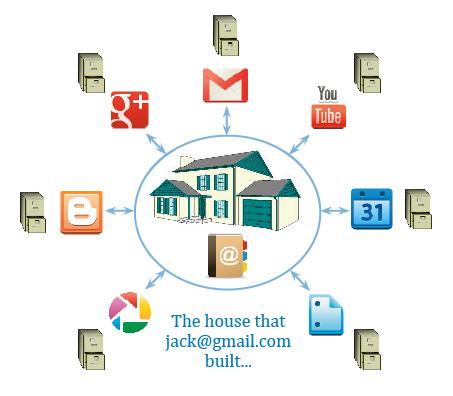
Photo Courtesy: Wendy Durham's Blog.
1. How Do I Get a Google Account?
For many of us, creating a Google Account happens automatically when we decide to set up a Gmail address. The username you choose becomes your permanent Gmail address, which serves as the Primary ID for the Google Account housing your services.
Using a Non-Gmail Address
If you don't use Gmail, you can still create a Google Account using an existing email address from Hotmail, Yahoo, or your ISP.
If you later add the Gmail product to that non-Gmail Google Account:
- The new Gmail address automatically becomes the Primary ID for display purposes across Google services.
- The original non-Gmail email address remains permanently connected as a Secondary / Alternate ID.
- You can use either address to sign in to the account.
Alternate Addresses vs. Recovery Addresses
Any non-Gmail address not currently linked to another Google Account can be added as an Alternate Address after email verification.
How to fix it:
- Sign in to the original Google Account at https://accounts.google.com/.
- Go to Google Account Settings (myaccount.google.com).
- Select Personal Info from the left panel and click on Email under the Contact Info section.
- Under the Alternate emails section, click Manage alternate emails to visit the alternate emails page, and click the Trash can icon to remove the listed address.
- Re-add that address under Recovery Email instead. Recovery emails carry no ID implications and strictly serve as an account recovery channel.
2. How Do I Use My Google Account?
Once logged in, you can easily switch between services using the 9-dot Google Apps launcher (the "waffle" menu) in the top-right corner.
Many people do not appreciate this structure, and simply sign in to Gmail to check their mail, and sign out again when finished. Consequently, when deciding to try out Calendar, Drive or Docs, they are asked to sign in or create a Google account. As they don’t realise they already have a Google account which houses their Gmail account, instead of signing in with their Gmail ID, they create a new Google account. When they decide they’d like to start a blog, they go to Blogger and repeat the same process. So many users actually end up with multiple Google accounts, each one often used for only one or two products, and have to sign in and out whenever they switch products so that they can access their stored product data.
3. Right Data - Wrong Account? Pitfalls & Scenarios
Because Google accounts stay signed in via browser cookies, users frequently end up signed into the wrong account without realizing it. Let’s try some examples to see how that can happen:
Common Multi-Account Scenarios
- Scenario A (Docs & Drive): Fred is signed into his personal Google account when he decides to draft an article for his next blog post—he clicks on Docs from the 9-dots Google apps launcher and is taken to the Docs product. He creates a new Google document, starts writing his article, and saves it. Next day, he signs into his work Gmail account, opens Docs, and finds to his horror that his document is missing! It isn’t, of course, but he is signed in to a different Google account to the one in which he created his masterpiece the day before, so that document isn’t available to him.
- Scenario B (Photos & Albums): John sets up Google Photos albums whilst still signed into the Google account he uses for work. He spends time setting up Albums, adding photos to them and sharing them with his friends. The next day, he checks his personal Gmail account for email, and whilst there decides to check for any comments from his friends on the shared photos. To his shock, when he clicks on Photos, he has no Albums, no Photos—it’s all gone! Not at all—it’s still all there in the Google account he used to create it, but it is not accessible unless he is signed in to that account.
- Scenario C (Shared Devices): A visiting relative signs in on your computer to check their Gmail for new messages. They forget to sign out—and you decide to do something you’ve been meaning to do for weeks, i.e. create a work Calendar. You click on the 9-dot Google apps launcher, and without checking the sign-in info in the top right-hand corner, click on Calendar and labour away putting all your work appointments and reminders into a new Calendar. But sadly, your nice new Calendar is now firmly connected to that guest’s Google ID....and is only accessible to you if you are signed in with their username and password.
4. Why Can't You Just "Merge" Accounts?
Let’s go back to our Google account house...
A few doors down from our “house” is another Google account. It has the same layout, with various Google products and their data occupying the different rooms. It may have a few different products to the house up the street - it may, for example, use YouTube and maybe it doesn’t have a Gmail account at all. It too will have its own address book on its own telephone table in its own lobby. But to enter this house, you can’t use the key from the house a few doors up. You have to use a different key - the unique username or “street address” for that house - before you can open the front door. And when you DO open the front door, and start visiting the rooms where the products live, you will find completely different sets of data in the filing cabinets. Even the address book on the lobby table is different from the one in the house next door...
Now imagine you owned both houses, and you wanted the products in the first house to be able to open the filing cabinets in the second house and vice versa. But they don’t have the front door key, so they can’t get in through the front door. You can’t change the locks so that the same key opens both doors - you’d just screw up the data because none of the products would know which filing cabinet it ought to be storing its data in, and none of the products would know where they had to look for their data.
To consolidate data, you have to manually copy files from House B and move them into House A. While Google doesn't offer an "Account Merge" button, services like Google Takeout allow you to export archives of your emails, documents, and photos to transfer manually. Some products (like Google Drive or Google Calendar) also allow direct sharing and permissions, letting one account view or edit content hosted on another without physically migrating the files.
5. Best Practices for Managing Multiple Accounts
Managing multiple Google accounts needs some discipline and does require planning if you are to get the best out of your working environment. So, to summarise:
- Remember that if you use Gmail you already have a Google account, and there is no need to create additional Google accounts for other products unless you specifically want to keep them separate from your email IDs.
- When signing up for a new product, think about whether that product can go in one of your existing Google accounts, or whether it needs an account of its own. Act accordingly by signing in to the relevant account, or creating a new one.
- When signing up for a new product, make sure you are NOT already signed in to an account you will regret associating that product with! Always check your address in the top right corner of the page.
- Don’t use “Keep me signed in” as a matter of course on all your accounts and always sign out from any account you are finished with UNLESS you are using Multiple Sign-in or Chrome Profiles and still want to keep other accounts for the session open.
- Simplify working with several accounts at once by using Chrome Browser Profiles, but make sure you know the rules!
- When deleting an account, make sure you confirm first (1) which account you are actually deleting (check the top right corner again!) and (2) which products you have attached to that account. Understand that you are deleting all that product data as well. If you want to keep any product data, export it (where possible) first.
- If you make mistakes, ensure you know what you can and can’t do with your data by using the advice in the Google Accounts Help Centre and on the Google Takeout help centre article.
- To help cope with utter disaster, make sure you do backup your data regularly. Check what export procedures are available for all your products: Docs can be downloaded to your computer, while you can add a Partner account for Photos and use Brand Accounts for better managing your YouTube channels. Contacts can be exported, as can your Calendars. Gmail can be backed up in a range of ways. See Gmail Backup Methods for detailed info on how to do that.
6. Google Account Reference Links
- Google Accounts Help Center: support.google.com/accounts
- Create a Google Account: accounts.google.com/signup
- Manage Your Google Account: myaccount.google.com
- Google Takeout (Data Export): takeout.google.com
- Multiple Sign-in Information: support.google.com/accounts/answer/1721977
- Security & Passkeys: myaccount.google.com/security
all i want to do is delete some of my emails,i have seven and want to keep two.
ReplyDeletePlease refer to details here - https://blogs-on-gmail.blogspot.com/2019/02/gmail101.html?m=1#C5Deleting and let me know?
DeleteWendy... I really like the way you write. Your explanations are clear and understandable. I wish I had more time to throughly get into everything you've covered.
ReplyDeleteHowever, maybe I missed it, but, I don't see where you answer the simple question; how can we eliminate two email addresses and still retain the other three?
Please just answer this question.
Please don't send us back into the archives by telling us to go into the stacks and find it in one of the books on floor seven.
Thank you.
~ Philip Holsworth
Can you please explain from where you want to get rid of those email addresses?
DeleteI agree, need to delete 2 email addresses from my account. I don't want to download and save the data, I just want to get rid of 2 email addresses and to keep my other 2 addresses. I just need to know how to do this.
ReplyDeleteDaphna
Can you please explain from where you want to get rid of those email addresses?
Deletei had same password for gmail and google account. but accidentally i have changed password for gmail keeping google account password unchanged. now i have to sign in twice for those two accounts. it is cumbersome. i want to set same password for the two accounts..pls help...thanks in advanced
ReplyDeleteAssuming you are talking about one Gmail username, abc@gmail.com, the phrase "but accidentally i have changed password for gmail keeping google account password unchanged." is an impossibility.
DeleteThe Google account has always had one password to sign to all its available services whether it is created using a Gmail or a non-Gmail address. So, whatever is the password for your Gmail, is also your password for Calendar, Photos, Drive, Maps, etc. for that account. Which is why, once you sign into your Google account or any specific service, you can seamlessly switch over to another product or service via the 9-dot Google Apps switcher icon.
Please try the following test and post an update.
1. First sign out of all Google accounts you may be signed into.
2. Type https://accounts.google.com/ and enter your Google username and password for that account.
3. Once signed in, click on the 9-dot Google Apps switcher icon and select Gmail to check if you are signed into Gmail for that account or not.